

From the Democratic School to the Open Source School
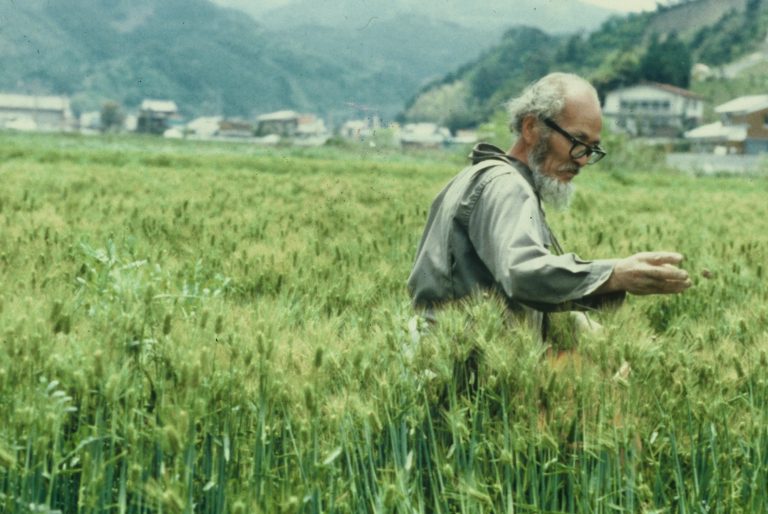
I sit in front of the screen on the train back from Brindisi with a clear image in my mind. It's a memory, a video of Masanobu Fukuoka launching seed bombs, mud balls containing several different seeds. The clayey mud covers the seeds, which can remain on the ground without being eaten by rodents or insects, but allows moisture to permeate. The spherical shape of the balls allows them to be thrown, rolled, or inserted into places where ordinary seeds would never be able to enter. If worked well throughout the year, seeds are a renewable and abundant resource; in fact, each bomb contains many different seeds at once. To paraphrase Fukuoka, We humans are not the ones who decide or can even imagine what is the right place for a seed to germinate.
The relationship between environment, resources, subject (in this case, the seed), and other subjects seems trivial, but it's extremely unpredictable. This applies to us designers, especially in this period in which the scope of our work is expanding into social, relational, physical, digital, ethical, and critical spheres never before seen.
September has begun again, and with it my pilgrimages to conferences and projects have begun again. As luck would have it, this month saw the conference Democratic School 2026 And Brindisi Open City of the Open Source School.
School, teaching, transmission, facilitation, training, maieutics, pedagogy. How can subjectively situated experiences nourish the experiences of others? How can these socialized experiences guide us toward scenarios other than the collapses we all perceive and continually inflict upon ourselves and ourselves (at least I do, speaking for myself)?
In this period of multi-scale pressure on the environment, politics, war, injustice, techno-feudalism and arrogance of the strong over the weak, we need to breathe, it would be important to find something to act on And not just something to defend ourselves against. The problem is that the media exposure we're subjected to on social networks weakens the word, making it just noise amidst other noises, incapable of creating desired scenarios where we can aim as individuals within communities. So if the word is submerged by other words sponsored with resources unattainable to us, do we lose the ability to generate other scenarios? Perhaps not. we still have the paperwork. In fact, the practices do not spread through the same broadcast route as the sponsored word: they pass through imitation among those who frequent it closely, for proximity rather than range, and therefore remain less exposed to that imbalance of resources, even if slower to spread.
Lately I have been studying and observing a lot about the transformative capabilities of “everyday practices”, those practices that an individual or a community repeat daily with Pleasure (if it brings enjoyment) or discipline (if one is aware of its importance even if it implies a burden). These everyday practices have the capacity to be viral and to situate themselves in other bodies that can rework them according to their own characteristics and in turn can spread them in new contexts. I am interested in looking at how collective practices create magic circles and like these open up passages towards speculative scenarios, which do not yet exist but which at the same time could be the germ of that something to act onIt's hyperstition: a fiction that, practiced long enough and by enough people, stops being fiction and begins to produce the effects it imagined.
Practices come in many forms: individual and collective, corporeal and dialogical, explicit and implicit. They surround us even when we don't put them into words: we perform them without having formally learned them, because our original context passes them down to us through imitative continuity, and they remain mostly unexamined. For Bandura Most human behavior is learned by observing others: from example (by imitation) we get an idea of how to perform new behaviors, and this encoded information guides subsequent action, avoiding errors. Questioning them, however, requires what Bateson calls learning 3, the rarest and most shocking level of learning: not correcting a choice, but reviewing the very system of alternatives with which we choose, a reflection on reflection.
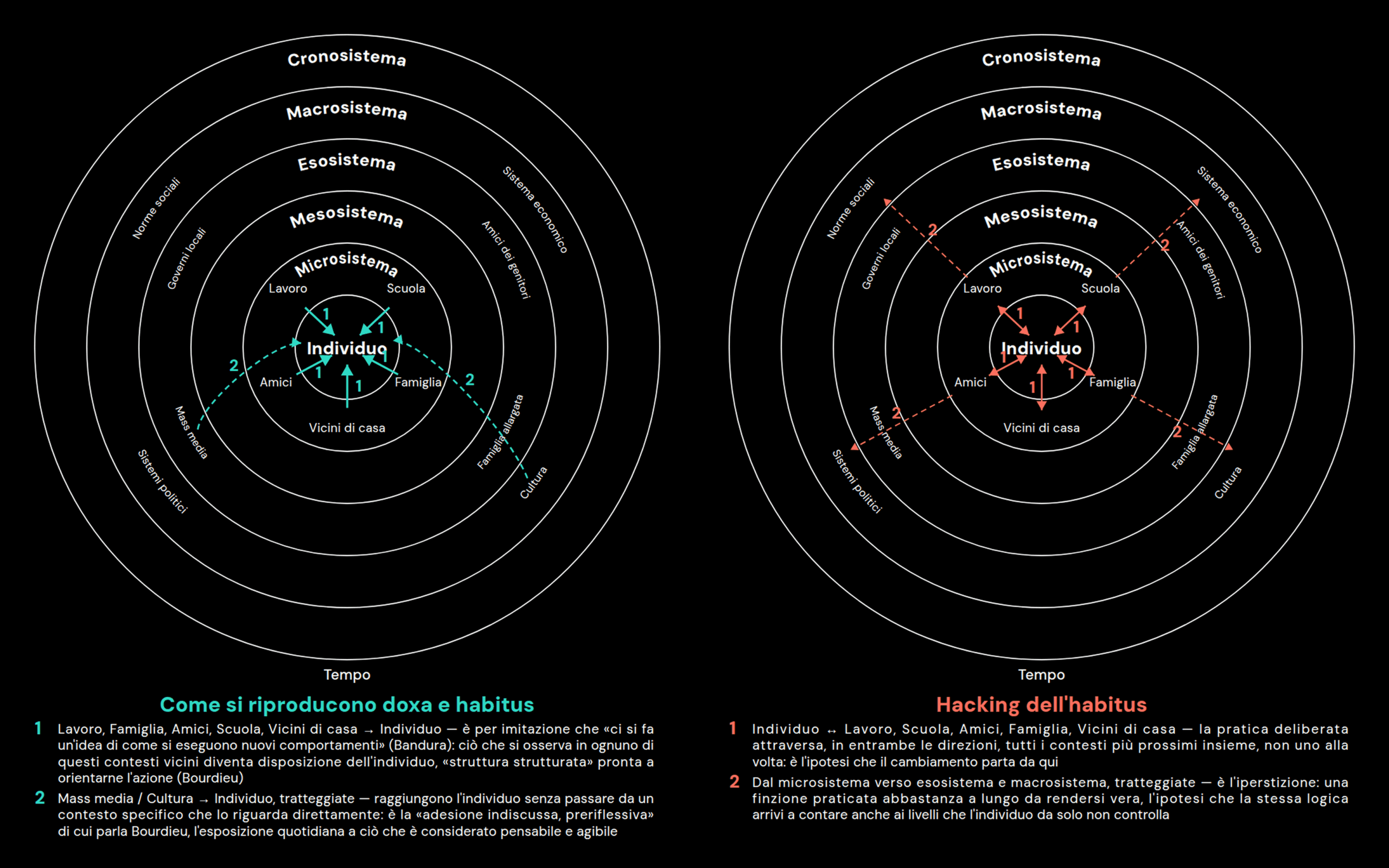
We now have behaviors that are somatically expressed in practices that percolate from one generation to the next and from dominant social contexts, towards individuals who often do not rationalize this information and who reproduce it without questioning it. This systemically gives rise to a status quo of the thinkable and the doable which normalizes behaviors, practices and knowledge, the doxa for Bourdieu.habitus It is the embodied part, the set of enduring and transposable dispositions that are sedimented through socialization: patterns of perception, judgment and action that are acquired from one's social position and which then guide, mostly without awareness, what one feels, thinks and does. It is a "structured structure predisposed to function as a structuring structure": product of the original condition and at the same time generator of practices that tend to reproduce it.
And here is the heart of the whole reflectionThe social conditions in which we grow up generate, through imitation, a habitus rooted in values we may not share; that habitus, in turn, generates practices that tend to reproduce those very conditions. Changing practices can be a catalyst for imagining and fostering new conditions.
Simply put, if we consciously modified our collective practices and designed them to be structuring a new structure consistent with our values, these could “infect” the status quo more than the word is currently capable of doing.
In this framework is still incredibly immature I find those Fukuoka seed bombs. Obviously, it's not certain what will germinate, when, where, or if these new plants will be able to reproduce, but that's the point. I could never know by interacting with such a complex context. I think it's important to identify the limitations, both subjective and biological. From this point on, however, even if a single practice is reproduced outside the circle in a new environment, this would already be a first sign.
At that time I think it's important to spread small everyday practices, trying to hack the habitus we've found ourselves inPractices that can be implemented in both permanent and temporary communities, and that can be simple, from facilitating work calls to creating and sharing a shared agenda, from speaking turns to exercising multiple forms of decision-making, to creating sharing circles at the end of a collective moment. Hoping that, by demonstrating new and different ways of being together in the present, we can envision other futures, discontinuous futures that do not reproduce the eternal present that late capitalism wants us to experience. By opening these magic circles, glimpsing what lies beyond the gap, then perhaps individual desire will multiply and become collective and it will be reproduced outside the circles as well. Hyperstition is at work once again: the shared fiction within the circle is beginning to produce the imagined effects outside it as well. For this to happen, practices alone will not be enough: we will also need to address the resources and time required to access these circles, otherwise we risk redistributing the form without redistributing the conditions. I have attempted to translate the steps I have described into graphics, contextualizing them within Bronfenbrenner's nested concept of systems.
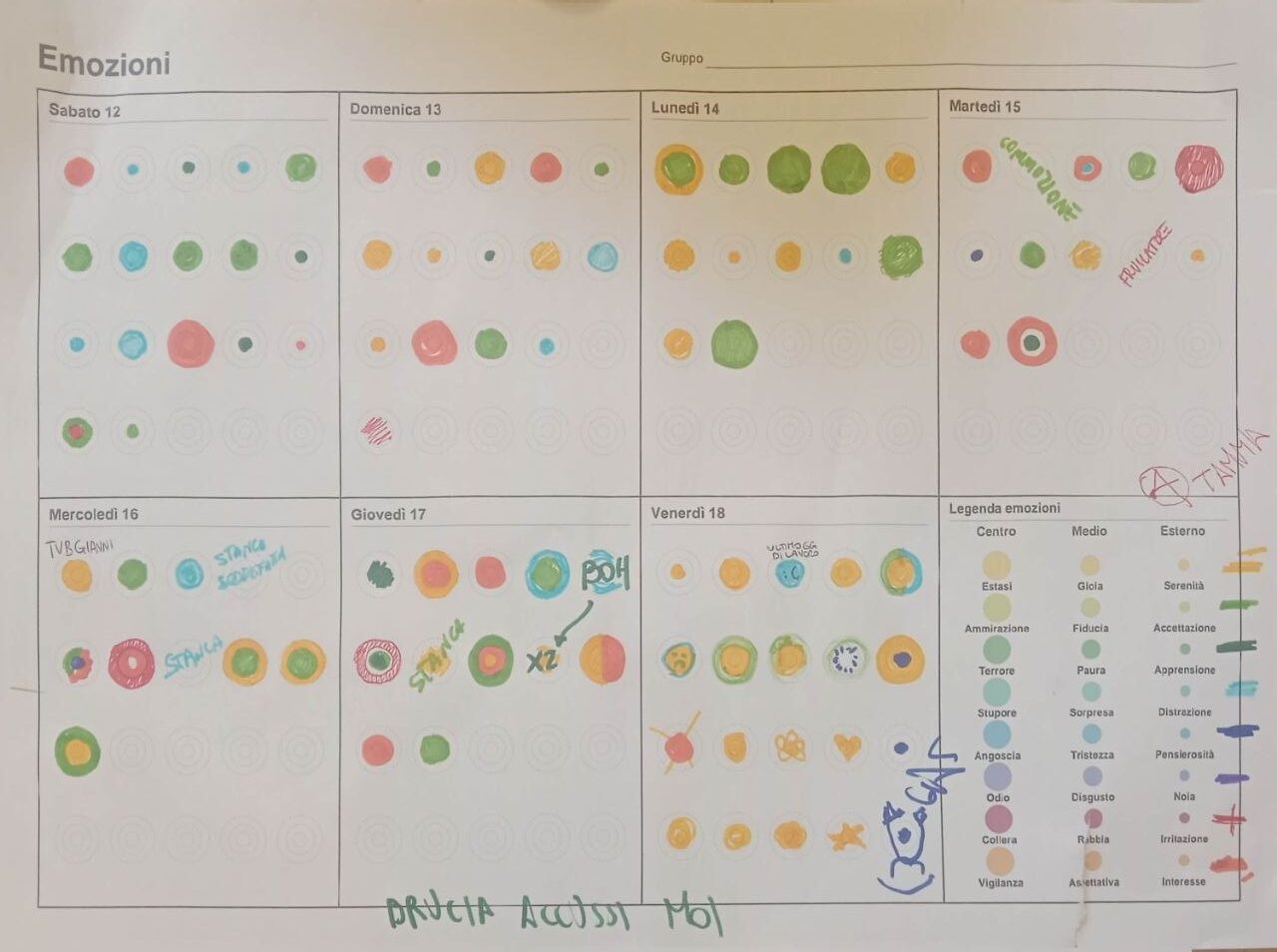
I tried to talk about this during the Democratic School 2026 conference, through research, telling an experiment based on a year and a half of practices in my doctoral groupAnd this is what I always tried to bring, but also to welcome, during Brindisi Città Aperta of the Open Source School, a very important experience of collective practice and participatory design that reawakens the very meaning of doing what I'm doing, a designer—why, for whom, with whom? How? Being human, why? For whom? With whom? How? By throwing seed bombs.
Bibliography
Bandura, A. (1977). Social learning theoryPrentice Hall.
Bateson, G. (1972). Steps to an ecology of mind: Collected essays in anthropology, psychiatry, evolution, and epistemology. University of Chicago Press.
Bourdieu, P. (1980). The practical sense. Éditions de Minuit.
Bronfenbrenner, U. (1979). The ecology of human development: Experiments by nature and design. Harvard University Press.
Fukuoka, M. (1975). The one-straw revolution: An introduction to natural farming. Rodale Press.
PS As I formalized this hypothesis, I realized that the thought I was trying to formulate was bigger than me, and that no matter how much study and effort I put into it, I couldn't make it as elegant and comprehensible as I imagined. The connections between the concepts were there, but I couldn't sustain them for more than a few moments. I wonder if certain thoughts need even more time. Or more people working on them together. Let's talk about it, let's find some intentional space, even if we also need to find the resources to do so.
PPS While writing, my thoughts often returned to Salvatore Iaconesi and the fact that we talked about these things so many times, and since he's gone, I haven't found anyone else with whom I could discuss them with the same depth. I miss you, Sal; we would have had so much fun at SOS.
AND MORE: I haven't spent much time recounting my experiences in their entirety, but for clarity, it should be noted that designing and building a public artificial intelligence for the Brindisi Neighborhood Houses in a week, with 60 people, most of whom didn't know each other, was an incredible experience. Obviously, it wouldn't have happened without a close-knit team, so I can't help but thank Kedy and Carlotta from my team for their constant attention, even during the most intense moments. But it was wonderful to see the original pirates again, with a few more scars and graying beards or hair, but with that ardour in their hearts that over time has also found room for healing. Thanks so much to Ale T, Daniele, Puria, but also to those who communicated the project so exemplarily: Rob, Carlotta, and Davide. Finally, to those who weren't in the groups but were always there to support us: Alberto, Ale Bale, Silvia, Martina, and Arianna. Of course, to all those who have made their fundamental contribution to the collective intelligence that has been created. Happy and grateful to have set sail with you, I'm already ready to set off on a new adventure.
Handwritten and revised with Claude Sonnet 5.0
